 Nationwide, including all across the South – it is legal and possible for transgender adults to access gender-affirming care. However, anti-transgender organizations and political actors have made no secret of their agenda to restrict – and ultimately, attempt to ban – gender-affirming care for transgender adults. In 2026, we’re seeing the clearest indications yet of how this agenda is impacting access to care for transgender adults across the South and gaining momentum on the policy and practical levels.
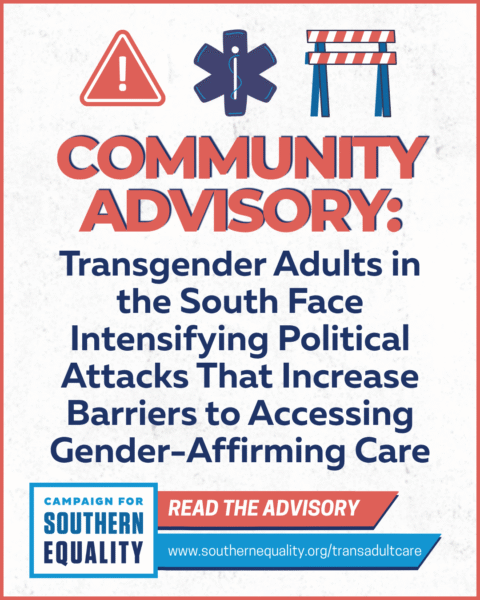
Now, the Campaign for Southern Equality has published a new community advisory that widens the aperture of our analysis from tracking isolated developments in specific communities to focus on the totality and impact of attacks on access across the South. It provides updates about adult gender-affirming care access in the South and resources for those seeking care in the following Southern states: Alabama, Arkansas, Florida, Georgia, Kentucky, Louisiana, Mississippi, North Carolina, South Carolina, Tennessee, Texas, Virginia, and West Virginia.
The South is home to approximately 722,800 transgender adults – more than one-third of all trans adults in the United States. The region has long been used as a testing ground for anti-LGBTQ+ policies, and once again in the region we are seeing a variety of levers being pulled to restrict access to care for transgender adults and thus create new barriers to care. For some, this makes it harder to book an appointment, harder to get to that appointment, and harder to pay for it; for others, it means that care has functionally become inaccessible in their local communities and they must seek it elsewhere. Such measures have a heightened impact on vulnerable populations, including people living with HIV, incarcerated individuals who may be denied care entirely, people enrolled in Medicaid, people who are reliant on public funding for health care, and veterans.
Encroachments on care access for adults are happening on the heels of a years-long attack on gender affirming care access for transgender young people. Since 2023, every Southern state except for Virginia (and a total of 27 states nationwide) has outright banned access to hormone therapy, puberty blockers, and surgery for transgender young people. Before 2022, no state law banned this care and, in fact, robust efforts were underway to expand access to gender affirming care for both youth and adults. This shifting landscape has increasingly been influenced by the federal government: The Trump Administration has taken executive and administrative actions to restrict access for transgender youth, regardless of state, and to invalidate the identities and unique needs of transgender adults.
While this Community Advisory focuses on the South, we are also seeing restrictions for healthcare access for trans adults in non-Southern states. We note them throughout and underscore that these alarming trends are happening across the nation. Please note that this advisory is not designed as a comprehensive log of every instance of care access being restricted.
Inside the advisory, you’ll read about the many ways that access to care for transgender adults is being impacted, including:
- Preemptive Closures or Changes to Care Provision
- State Laws Banning All Public Funding for Gender Affirming Care
- State Policies Regulating Provision of Care
- Federal and State Bans on Gender-Affirming Care for Incarcerated People
- Health Insurance Restrictions
- On the Radar Screen: Emerging Policies Restricting Care Access for Adults
We also share resources for impacted transgender adults. These include:
- Talk to your provider about how they are responding to attacks on adult gender-affirming care access. Ask your provider if they are impacted by recent laws or policy changes from the federal government. Underline the importance of this care for you and your family.
- If your healthcare access has been impacted, report it to the Campaign for Southern Equality. Click here to fill out our confidential survey and tell us about your experience.
- If you live in the South and have lost access to gender-affirming care at your local provider, you can check out CSE’s Trans in the South guide to find another gender-affirming care provider in your area.
- If you have lost access to gender-affirming care at your local provider, telehealth can be an alternative. In the Trans in the South guide you’ll find a new section devoted to telehealth options available here.
- If you are experiencing health insurance coverage barriers or otherwise struggling to afford gender-affirming care, local mutual aid or practical support organizations may be able to help. Check out our Funding Your Transition resource for a list of organizations that offer financial assistance for gender-affirming care, or search for a local trans mutual aid group in your area.